
Graph Search Agent Tool
When publishing a graph with the Visual Graph Editor webapp, the resulting graph can be leveraged as a dynamic knowledge base for Retrieval-Augmented Generation (RAG) applications using the Graph Search Agent Tool.
You can also point the tool to an unmanaged Neo4j database directly.
This tool integrates with Agent hub, enabling an LLM to translate natural language questions into Cypher queries. The queries are executed against your graph, and the results are returned to the agent to provide contextually accurate answers.
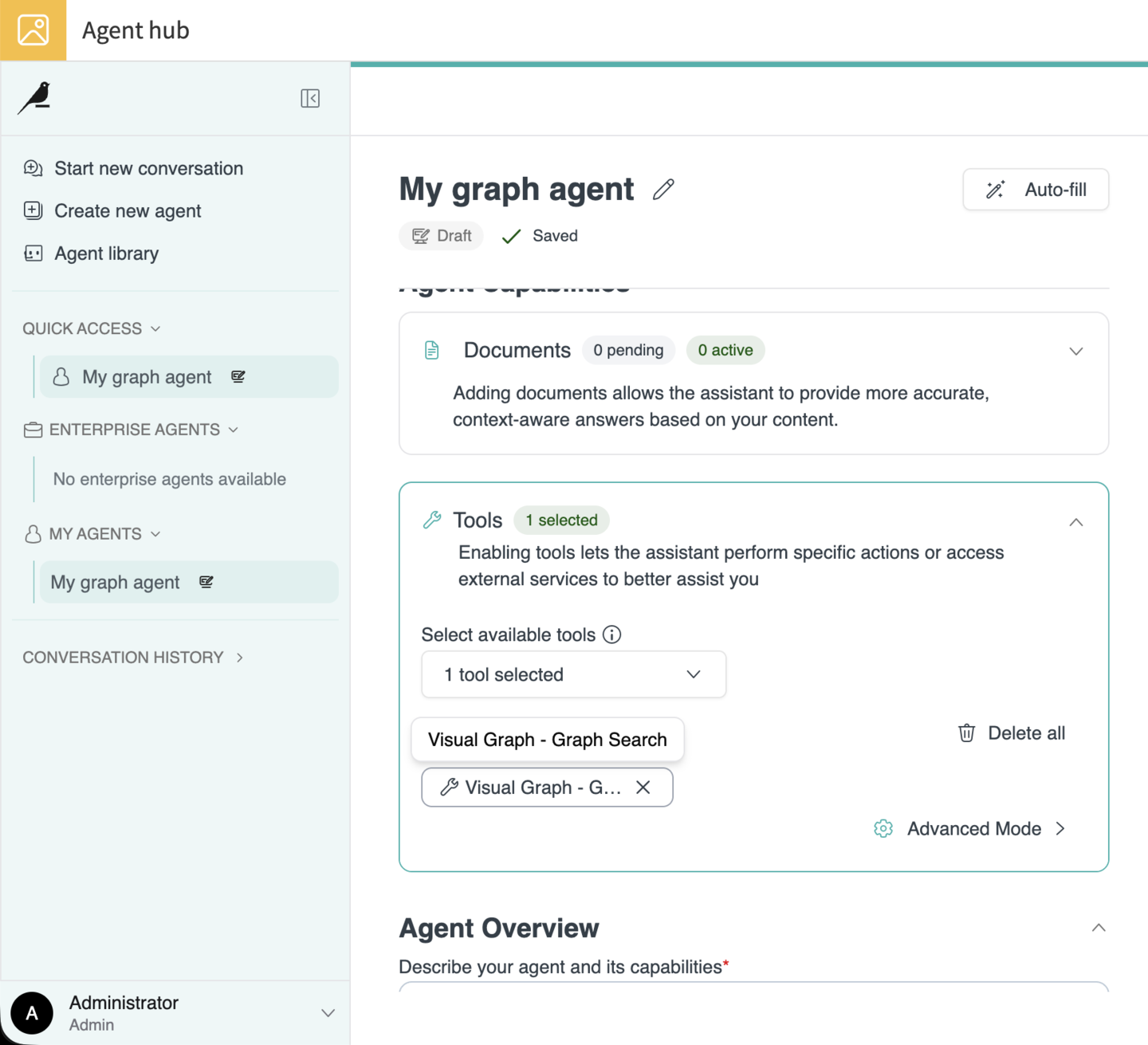
You need to select the Graph Search Agent tool that you created as one of your agent capabilities.
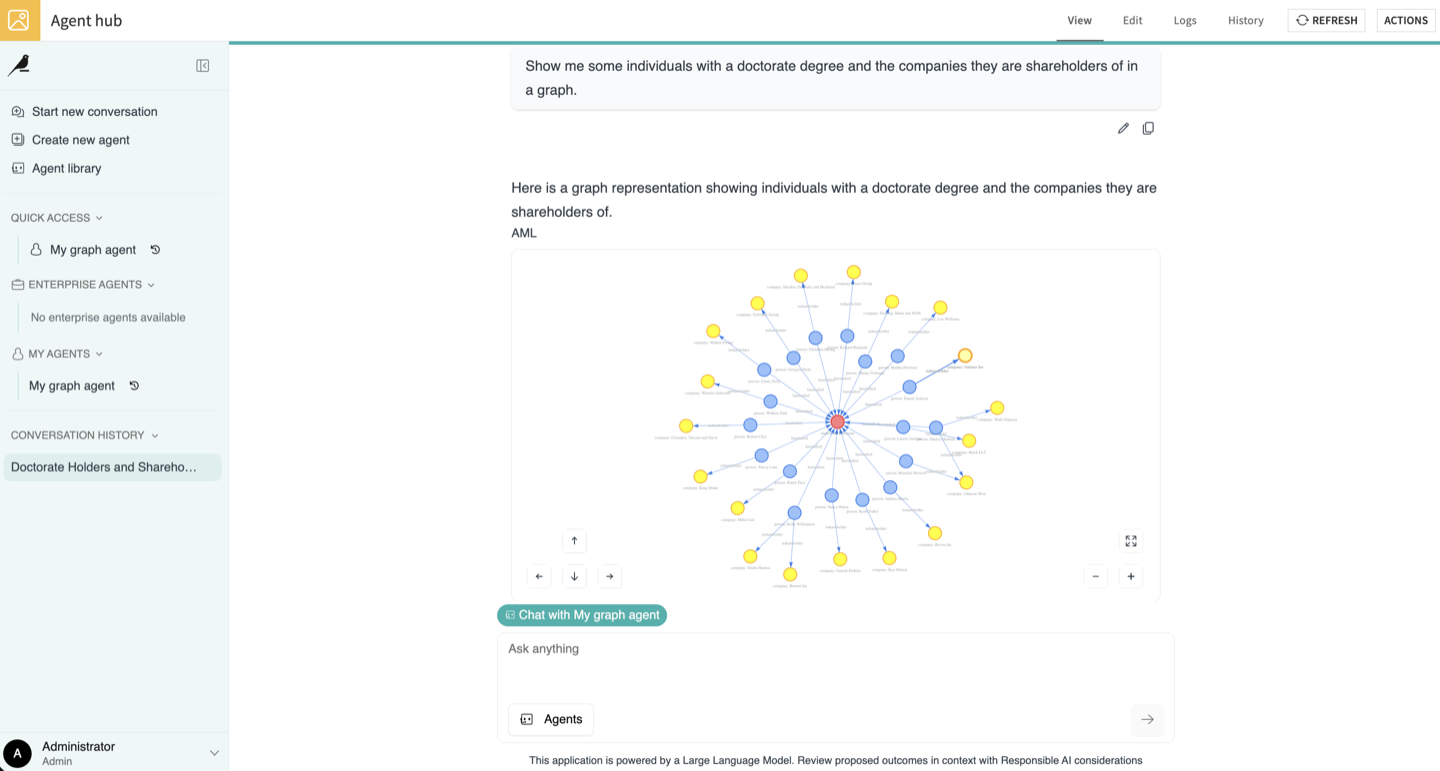
You can then start querying your graph in a conversation.
Note
- This graph rendering is available with the following plugin versions:
Agent Hub: version 1.6.0 or later
Visual Graph: version 1.4.0 or later
Settings
LLM connection: Select the language model that will handle the natural language-to-Cypher conversion.
Graph folder (Optional): Choose the Dataiku Folder containing your published graph database. Leave it empty to query an unmanaged Neo4j database directly.
Database type: If a graph folder is provided, the database type is detected from that folder. Otherwise, select Neo4j (unmanaged) to target an unmanaged Neo4j database directly.
Neo4j connection: If Database type is set to Neo4j, select the Neo4j connection to be used by the tool for querying the database.
Database name: If you are querying an unmanaged Neo4j database directly, select the database name to use.
Cypher query timeout (seconds): Set a maximum execution time for queries. This acts as a crucial guardrail to prevent long-running queries from impacting performance.
Max threads: Limit the number of threads used by the built-in graph database. Use 0 for the database default.
Verbose mode: Enable detailed logs for troubleshooting.
Tool instructions: Provide a concise, high-level description of the graph’s content and purpose. This text gives the LLM additional context to improve query generation. You do not need to describe the schema itself, as it is automatically included in the context.
Note
The Graph Search Agent Tool is well suited to querying an unmanaged Neo4j database through a read-only Neo4j preset when you want to protect that database from accidental changes.
Per-user OpenID Connect (OIDC) is not supported for this tool in Agent Hub. See Neo4j single sign-on for the Neo4j authentication modes.
Testing the tool
The Design tab’s test panel provides Load sample query for the selected graph. The sample query includes LIMIT 5.